
Kansas City, January 9, 2026
Kansas City’s economy is buzzing as local boutiques in Liberty leverage the Kansas City Chiefs’ fandom to ignite retail success. While small businesses prosper, the community grapples with ongoing discussions regarding the potential relocation of the Kansas City Royals’ stadium, undergoing debate over economic impacts and resident concerns. The interplay between local commerce and large-scale development illustrates both entrepreneurial spirit and the challenges of urban planning in the region.
<body>
<h1>Kansas City’s Economic Playbook: Local Boutiques Thrive, Stadium Debate Intensifies</h1>
<p>As the Kansas City Chiefs consistently vie for football’s highest honors, the spirit of victory fuels more than just fan excitement; it sparks significant economic activity, particularly for <b>Kansas City small business</b> owners. This local entrepreneurial drive is a cornerstone of <b>Kansas City MO business</b>, showcasing how community pride translates into commercial success. Simultaneously, the region grapples with complex questions surrounding large-scale development, as discussions continue regarding a potential new baseball stadium, highlighting the diverse perspectives on <b>Midlands economic growth</b> and community planning.</p>
<p>The dynamic interplay between grassroots commerce and major development projects defines much of the economic narrative in the greater Kansas City area. Local entrepreneurs, with their adaptability and responsiveness, are adept at capitalizing on moments of collective enthusiasm. This ingenuity, often flourishing with minimal regulatory hurdles, allows businesses to quickly meet consumer demand, driving local job creation and fostering a robust economic environment. However, larger projects, while promising substantial investment, also bring considerable public discourse, balancing projected economic gains against potential community impacts.</p>
<h3>Chiefs Fandom Fuels Local Retail Innovation</h3>
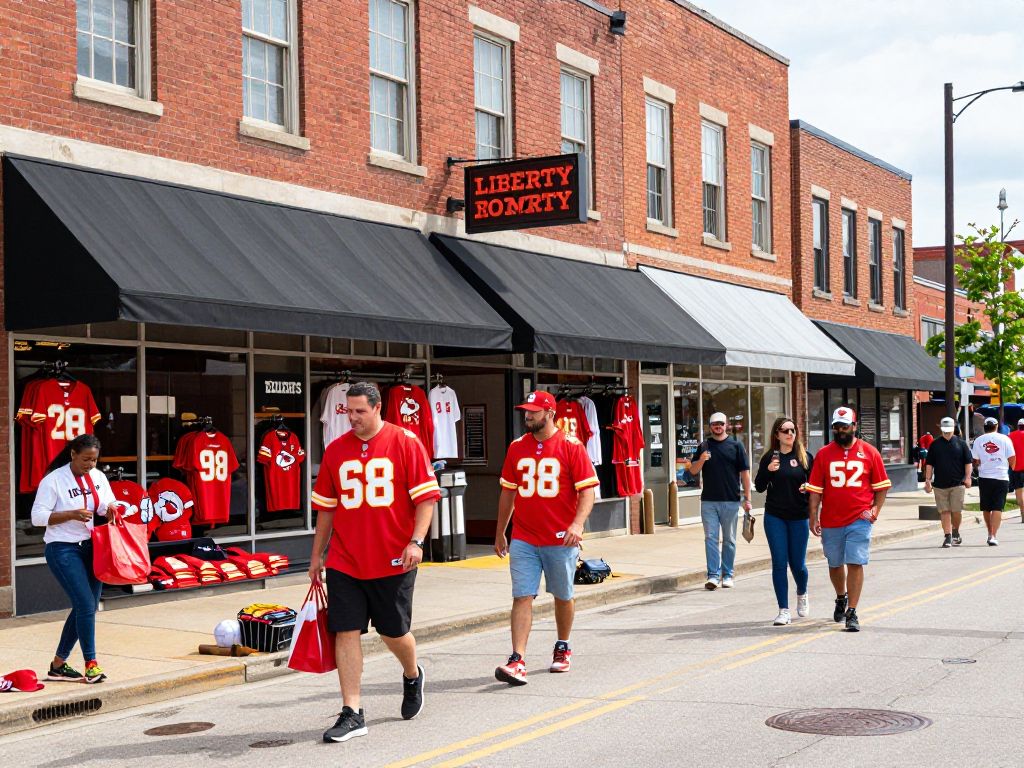
<p>In Liberty, Missouri, local boutiques are demonstrating remarkable resilience and entrepreneurial spirit by offering a variety of Kansas City Chiefs-themed merchandise. This proactive approach by <b>Missouri MO entrepreneurs</b> allows fans to celebrate their team’s anticipated success, particularly in the lead-up to major events like the Super Bowl. Businesses like Love Letters KC, a boutique in Liberty, provide a selection of Chiefs gear, including sweatshirts, tees, and other game-day apparel. This store also notably carries Erimish jewelry, a Joplin-based brand worn by public figures associated with the team.</p>
<p>Further showcasing this trend, KC Merch Co, also situated in Liberty, MO, actively promotes Chiefs-themed items, featuring “Post-Season Sale” collections that include hoodies and crewnecks, making fan apparel accessible to a broad audience. The availability of such promotions underscores the quick adaptation of local retail to ongoing sports seasons and fan enthusiasm. Another significant retail presence, Rally House Liberty, offers a comprehensive range of Chiefs merchandise, from jerseys of star players like Patrick Mahomes and Travis Kelce to various apparel and fan essentials, catering to the strong local demand for team gear. These businesses exemplify how local commerce effectively responds to consumer interest, creating a vibrant marketplace for dedicated fans.</p>
<h3>The Aspiria Campus and the Royals Stadium Discussion</h3>
<p>Beyond the immediate triumphs of local businesses, the broader Kansas City metropolitan area is engaged in a significant discussion about future large-scale developments. A prominent topic involves the potential relocation of the Kansas City Royals baseball stadium to the Aspiria campus at 119th Street and Nall Avenue in Overland Park, Kansas. This site, strategically located near the border of Overland Park and Leawood, has become a focal point for robust debate regarding urban planning, economic incentives, and community impact.</p>
<h3>Community Concerns Shape Development Dialogue</h3>
<p>The prospect of a major league baseball stadium at the Aspiria campus has elicited strong reactions from local residents, homeowner associations, and municipal leadership. Concerns primarily revolve around potential increases in traffic congestion, elevated noise levels, enhanced light pollution, and strain on public safety resources and emergency access. Residents in affected neighborhoods, such as Hawthorne Valley and Hawthorne Place, have voiced apprehensions about preserving the suburban character of their communities, fearing that a stadium could disrupt the existing peaceful environment.</p>
<p>The City of Leawood has formally expressed that its City Council cannot support the Aspiria campus as an appropriate location for a stadium, sharing residents’ concerns about its potential impacts on infrastructure capacity, nearby schools, medical facilities, senior living communities, and established single-family residential areas. Prominent institutions like T-Mobile and the Jewish Community Centers Association, key contributors to the economic and cultural fabric of the area, have also conveyed concerns regarding the proximity of a stadium and its anticipated negative effects. In response, the Kansas City Royals have affirmed their commitment to working collaboratively with communities, emphasizing a desire to create a “generational home” that prioritizes the health, safety, and traffic concerns of their neighbors.</p>
<h3>Economic Projections and Expert Perspectives</h3>
<p>Proponents of new stadium developments often highlight significant economic benefits. For instance, economic projections for a proposed Crossroads ballpark (an alternative site) included one-time construction benefits such as 26,000 jobs created, $1.8 billion in labor income, and $3.8 billion in total economic impact. Perpetual annual benefits were projected to include 8,400 new jobs, $440 million in labor income, and $1.2 billion in economic output from district operations, along with $79 million in new tax revenues annually for the area. These figures underscore the potential for substantial private investment and job creation.</p>
<p>However, these economic projections have been met with skepticism by independent sports economists. Many experts argue that new stadiums, regardless of their location, often do not deliver the anticipated economic boom to cities. A common critique is that much of the spending attributed to new stadiums represents a diversion of existing local spending rather than genuinely new economic activity. Concerns have also been raised about the magnitude of job creation figures during construction, with some economists finding them to be notably high. Furthermore, the long-term profitability and debt repayment for such large-scale projects, particularly those funded through mechanisms like STAR bonds, have been questioned, especially when a significant portion of visitors from outside the immediate region is required to meet targets.</p>
<p>Kansas lawmakers are considering the use of Sales Tax and Revenue (STAR) bonds to finance a significant portion, potentially up to 70%, of stadium costs. This State-level funding mechanism is intended to attract major projects by dedicating new sales tax revenue generated within a district to pay off development bonds. While STAR bonds have been successfully used for smaller sports venues within Kansas, experts warn that applying them to a project of this unprecedented scale for either the Chiefs or Royals carries considerable risk and may not generate sufficient new economic activity to justify the investment.</p>
<h3>Balancing Growth with Community Values</h3>
<p>The discussions surrounding both the thriving local business scene and the proposed stadium highlight a fundamental tension in economic development: fostering growth while preserving community character. The adaptability of <b>Kansas City small business</b> owners in Liberty, leveraging team success to boost local commerce, showcases the positive ripple effects of private initiative and consumer enthusiasm. Conversely, the stadium debate underscores the importance of transparent planning, community engagement, and careful financial stewardship when considering large public-private partnerships.</p>
<p>For Kansas City and the wider <b>Midlands economic growth</b>, thoughtful leadership is crucial. Supporting entrepreneurial innovation through environments that encourage private investment and minimize unnecessary regulatory burdens can foster organic growth. Simultaneously, major infrastructure and development projects require rigorous evaluation of economic claims and a commitment to addressing the legitimate concerns of affected neighborhoods and communities. The ultimate goal remains a balanced approach that promotes prosperity while enhancing the quality of life for all residents.</p>
<h3>Conclusion</h3>
<p>Kansas City’s economic landscape is a vibrant tapestry woven from the threads of local entrepreneurship and significant development debates. From the bustling Liberty boutiques capitalizing on Chiefs fervor to the contentious discussions about a new baseball stadium, the region demonstrates an active pursuit of economic vitality. The resilience and innovation of <b>Missouri MO entrepreneurs</b> continue to drive local commerce, adapting to market demands and contributing significantly to the regional economy. As the dialogue on large-scale projects progresses, it emphasizes the need for a balanced approach that values both economic expansion and community well-being. Residents are encouraged to support their <b>Kansas City MO business</b> community and remain engaged in the ongoing conversations that shape the economic future of the Kansas City metropolitan area.</p>
<h3>Frequently Asked Questions (FAQ)</h3>
<dl>
<dt>What kind of Chiefs gear promotions are available in Liberty, MO?</dt>
&dd>Liberty, MO boutiques like Love Letters KC offer Chiefs gear including sweatshirts, tees, and game-day apparel. KC Merch Co, also in Liberty, features Chiefs-themed items and “Post-Season Sale” collections, including hoodies and crewnecks. Rally House Liberty also provides a wide range of Chiefs merchandise, such as jerseys for Patrick Mahomes and Travis Kelce.</dd<
<dt>Where is a new baseball stadium being considered for the Kansas City Royals?</dt>
&dd>A new baseball stadium for the Kansas City Royals is being considered at the Aspiria campus, located at 119th Street and Nall Avenue in Overland Park, Kansas.</dd>
<dt>What are the community concerns regarding the proposed stadium location?</dt>
&dd>Community concerns include potential increases in traffic congestion, elevated noise levels, light pollution, and strain on public safety resources and emergency access. The City of Leawood, along with institutions like T-Mobile and the Jewish Community Centers Association, have also expressed concerns about impacts on infrastructure, schools, medical facilities, and residential areas.</dd>
<dt>What are the economic projections for a new stadium, and what do economists say?</dt>
&dd>Economic projections for a potential Crossroads ballpark (an alternative site) suggested one-time benefits of 26,000 jobs, $1.8 billion in labor income, and $3.8 billion in total economic impact during construction. However, many independent economists argue that new stadiums often do not deliver the promised economic boom, and spending may be a diversion of existing funds rather than truly new economic activity.</dd>
<dt>How might a new stadium be funded in Kansas?</dt>
&dd>Kansas lawmakers are considering the use of Sales Tax and Revenue (STAR) bonds to finance up to 70% of stadium costs. This State-level funding mechanism would dedicate new sales tax revenue generated within a district to pay off development bonds. Experts caution about the risks and the unprecedented scale of such a project for STAR bonds.</dd>
</dl>
<script type=”application/ld+json”>
{
“@context”: “https://schema.org”,
“@type”: “FAQPage”,
“mainEntity”: [{
“@type”: “Question”,
“name”: “What kind of Chiefs gear promotions are available in Liberty, MO?”,
“acceptedAnswer”: {
“@type”: “Answer”,
“text”: “Liberty, MO boutiques like Love Letters KC offer Chiefs gear including sweatshirts, tees, and game-day apparel. KC Merch Co, also in Liberty, features Chiefs-themed items and “Post-Season Sale” collections, including hoodies and crewnecks. Rally House Liberty also provides a wide range of Chiefs merchandise, such as jerseys for Patrick Mahomes and Travis Kelce.”
}
},{
“@type”: “Question”,
“name”: “Where is a new baseball stadium being considered for the Kansas City Royals?”,
“acceptedAnswer”: {
“@type”: “Answer”,
“text”: “A new baseball stadium for the Kansas City Royals is being considered at the Aspiria campus, located at 119th Street and Nall Avenue in Overland Park, Kansas.”
}
},{
“@type”: “Question”,
“name”: “What are the community concerns regarding the proposed stadium location?”,
“acceptedAnswer”: {
“@type”: “Answer”,
“text”: “Community concerns include potential increases in traffic congestion, elevated noise levels, light pollution, and strain on public safety resources and emergency access. The City of Leawood, along with institutions like T-Mobile and the Jewish Community Centers Association, have also expressed concerns about impacts on infrastructure, schools, medical facilities, and residential areas.”
}
},{
“@type”: “Question”,
“name”: “What are the economic projections for a new stadium, and what do economists say?”,
“acceptedAnswer”: {
“@type”: “Answer”,
“text”: “Economic projections for a potential Crossroads ballpark (an alternative site) suggested one-time benefits of 26,000 jobs, $1.8 billion in labor income, and $3.8 billion in total economic impact during construction. However, many independent economists argue that new stadiums often do not deliver the promised economic boom, and spending may be a diversion of existing funds rather than truly new economic activity.”
}
},{
“@type”: “Question”,
“name”: “How might a new stadium be funded in Kansas?”,
“acceptedAnswer”: {
“@type”: “Answer”,
“text”: “Kansas lawmakers are considering the use of Sales Tax and Revenue (STAR) bonds to finance up to 70% of stadium costs. This State-level funding mechanism would dedicate new sales tax revenue generated within a district to pay off development bonds. Experts caution about the risks and the unprecedented scale of such a project for STAR bonds.”
}
}]
}
</script>
<h3>Key Aspects of Kansas City’s Economic Landscape</h3>
<table border=”1″>
<thead>
<tr>
<th>Aspect</th>
<th>Detail</th>
<th>Scope</th>
</tr>
</thead>
<tbody>
<tr>
<td>Local Business Innovation</td>
<td>Liberty boutiques (e.g., Love Letters KC, KC Merch Co, Rally House Liberty) offer Chiefs gear and promotions.</td>
<td>Local</td>
</tr>
<tr>
<td>Proposed Stadium Location</td>
<td>Aspiria campus at 119th Street and Nall Avenue in Overland Park, Kansas.</td>
<td>Local</td>
</tr>
<tr>
<td>Community Opposition</td>
<td>Concerns about traffic, noise, public safety, and impact on neighborhoods from residents and City of Leawood.</td>
<td>Local</td>
</tr>
<tr>
<td>Economic Projections (Royals)</td>
<td>26,000 jobs, $1.8B labor income (construction); 8,400 new jobs, $440M labor income, $1.2B economic output annually (Crossroads site estimates).</td>
<td>Local</td>
</tr>
<tr>
<td>Economist View on Stadiums</td>
<td>Skepticism that new stadiums deliver promised economic booms; spending often redirected, not new.</td>
<td>Nationwide</td>
</tr>
<tr>
<td>Proposed Funding Mechanism</td>
<td>State-level Sales Tax and Revenue (STAR) bonds in Kansas, potentially covering up to 70% of stadium costs.</td>
<td>State-level</td>
</tr>
</tbody>
</table>
</body>
Deeper Dive: News & Info About This Topic
HERE Resources
Kansas City Businesses Face AI Search Shake-Up
Busey Bank Expands Local Influence in Kansas City
Kansas City Small Business Boosts Workplace Wellness
Investing in Local Talent: JCCC’s Business Training Fuels Kansas City Growth
Kansas City: Tiffany Greens Golf Club and 834 Acres Sold to New Owners
Kansas City Child Care Providers Struggle with Payment Delays
KC’s Open Doors: Pop-Ups Ignite World Cup Business Boom
Kansas City Hosts Vibrant Weekend of Community Events
KC Restaurant Week Ignites Local Economy
Royals Explore Future Ballpark Site Options in Kansas City